Acoustic waveguide designed for a JBL 2412H-1 compression driver
Repurposing the 1″ HF driver from a JBL Control 328C ceiling speaker into a two-way with speaker simulated directivity validated from the crossover to 20 kHz.
I made a set of speakers with the JBL Control 328C which has a decent 25.4 mm-exit titanium compression driver. I wanted to pull that driver and build a proper two-way around it with it's 8″ woofer. Because it would no longer be coaxial it would need a waveguide, and i wanted one with roughly 90° conical coverage that holds pattern down to the 1.9 kHz crossover, in a rectangular format no wider than 14″ to match the already built speaker cabinet.
The geometry is an OS-SE waveguide generated parametrically in Ath4: 45° design half-angle from a 25.4 mm throat, morphed over the last 75% of its length from a round cross-section into a 340 × 215 mm rounded rectangle. Directivity was simulated with the boundary element method using Boundary Lab (JW Sound's open-source BEM front-end for Ath meshes), solved with its Julia BEAT engine, dense Burton–Miller BEM, accelerated on an RTX 2060 with quarter-symmetry, plus free-field observation at 2 m.
Getting trustworthy numbers took several attempts, the early cabinet simulations failed basic physicality checks apparent from the negative radiation resistance, which was eventually traced to a subtle meshing defect.
The production dataset, 46 frequencies, 1/12-octave, 1.5–20 kHz, 37 polar angles per plane, was validated on a ladder, mesh topology checks; a discretization bound against a λ/6-everywhere float64 reference (0.63 dB mean deviation at 18 kHz); and an independently written bempp-cl solver, which itself checked against analytic sphere and piston solutions, reproducing the production solver to under 0.001 dB at every angle on an identical mesh. The simulation was done largely by Claude Code agents using Ath4 + gmsh + Boundary Lab/BEAT + bempp-cl.


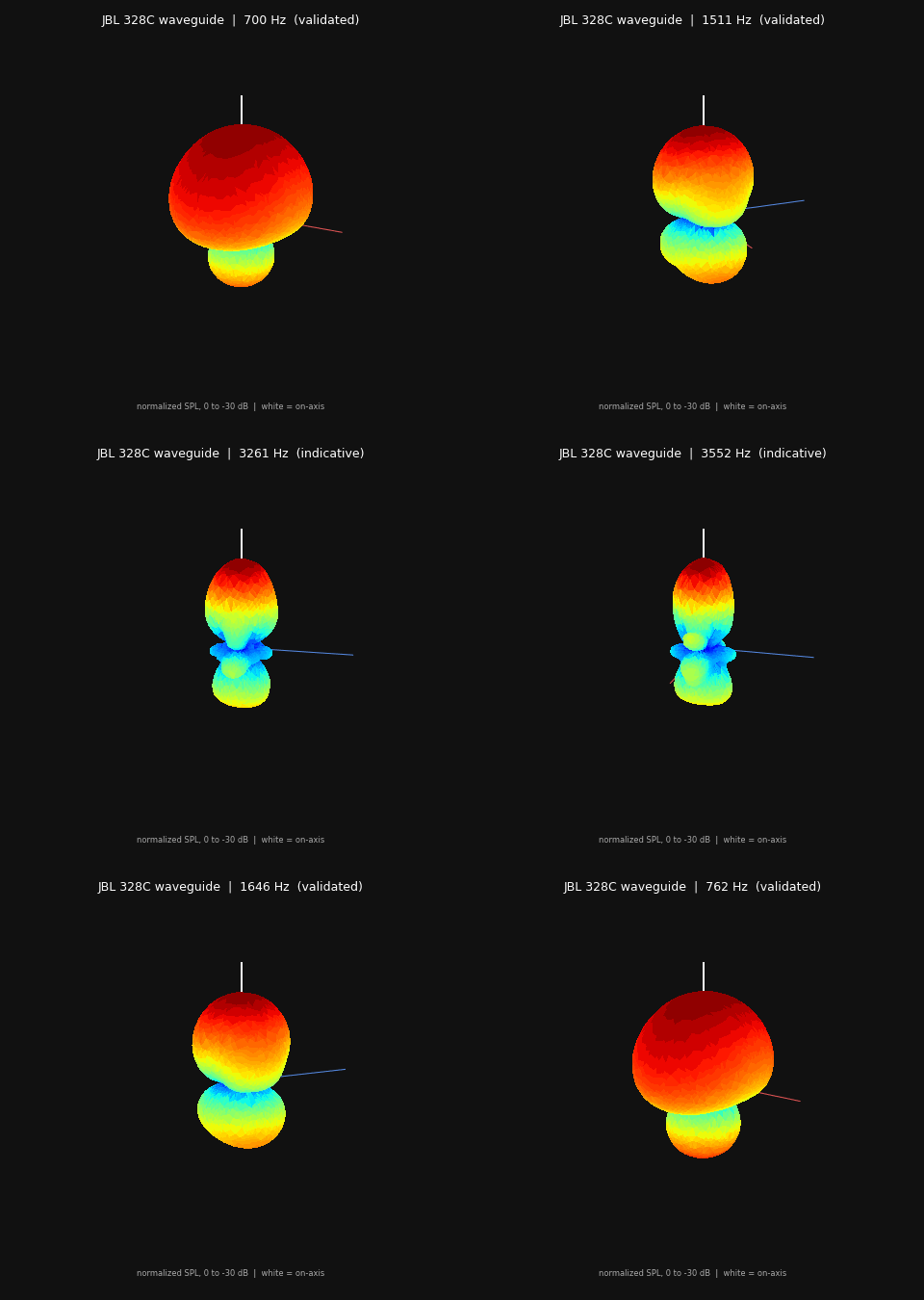
At the 1.9 kHz crossover the pattern is 91° horizontal / 65° vertical with a smooth 7.8 dB directivity index, and horizontal control holds ~75–92° up to about 6.5 kHz.
The simulation also exposed two real defects, both traceable to how aggressively the morph squeezes the round profile into the wide-format mouth (−84 mm of height, +34 mm of stretch: a mid-band bloom at 6.7–8.4 kHz where the pattern balloons past 120° and the DI briefly goes negative, and a vertical collapse to 8–15° at 12–14 kHz that a horn-only control run confirmed is intrinsic to the waveguide, not the cabinet.